

The mission of the RUM Community Group is to improve and expand the capabilities of developers and businesses who are using Real User Monitoring (RUM) to measure user experience on the web.
performance.now() 2024 was the year we officially launched the W3 RUM Community Group. The idea to form a community group around real user monitoring (RUM) came from the desire to come together as vendors, organizations and even independent consultants to identify opportunities to improve our tooling and push the boundaries of what’s possible. Our goal was to create a space to come together as a community focused on improving the user experience.
Ironically, the group was “founded” in the backroom of a church in Amsterdam, which sounds very top secret and shady. Like a guild.
And it sort of is. So let us introduce you to this “guild”, and what we do and why. Maybe afterwards you’d like to join us?
Who we are
Nic Jansma (Distinguished Software Engineer at Akamai/ mPulse), Cliff Crocker (CPO of SpeedCurve) and Karlijn Löwik (CEO of RUMvision) – co-chairs of the RUMCG.
The mission of the RUM Community Group is to improve and expand the capabilities of developers and businesses who are using Real User Monitoring (RUM) to measure user experience on the web.
From a “secret” backdoor meeting to a public W3C community
Credit for the idea of the RUMCG goes to Nic – as many of you know, he’s been one of the W3 WebPerf working group chairs for years and has a long history of RUM and web performance stewardship. He first proposed a similar initiative back in 2021, already reaching out to RUM leaders, but 2024 was the year things kicked off.

In September, just before TPAC, the group was proposed.
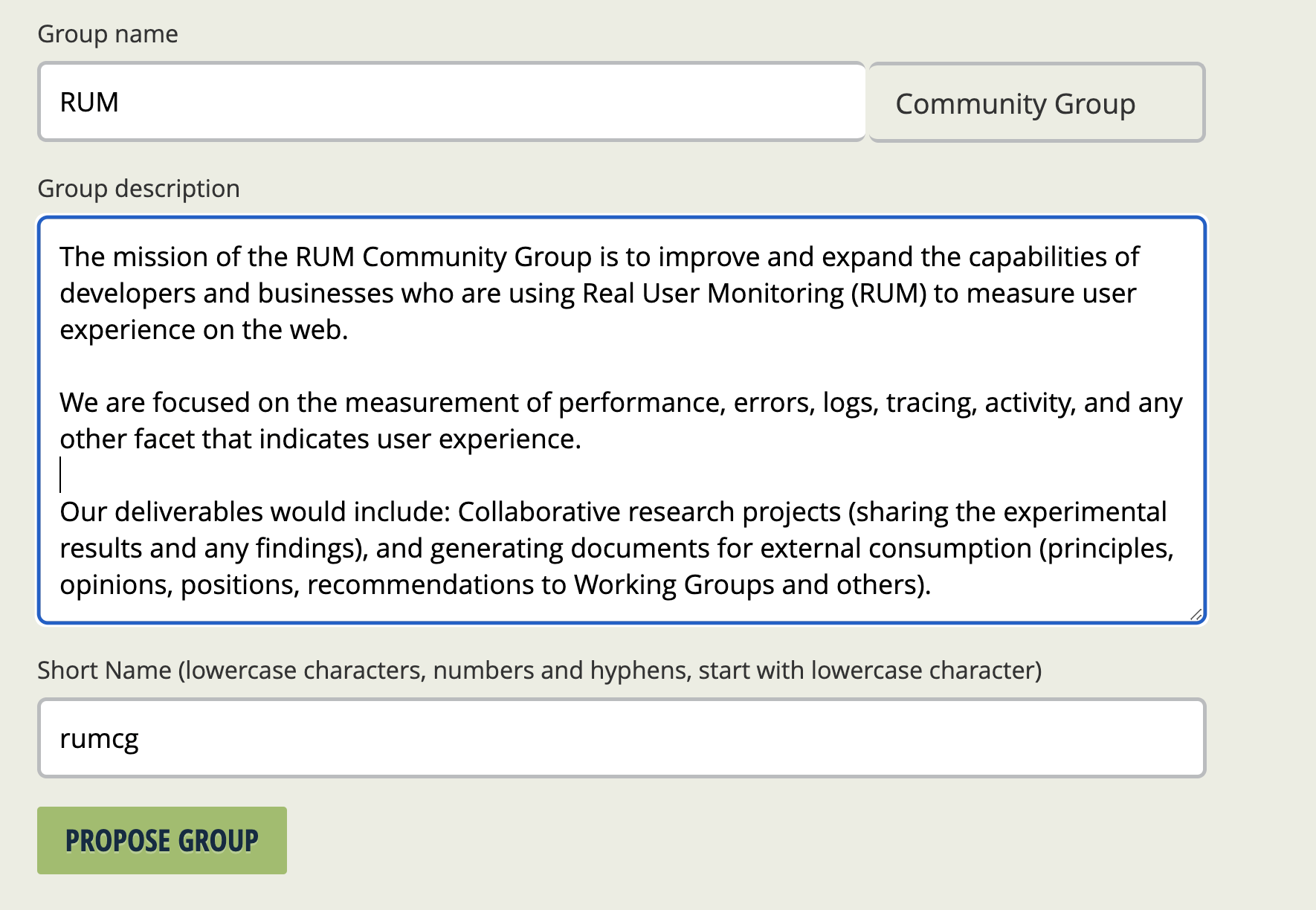
And at Perfnow 2024, PPK was kind enough to give us a platform to announce it.
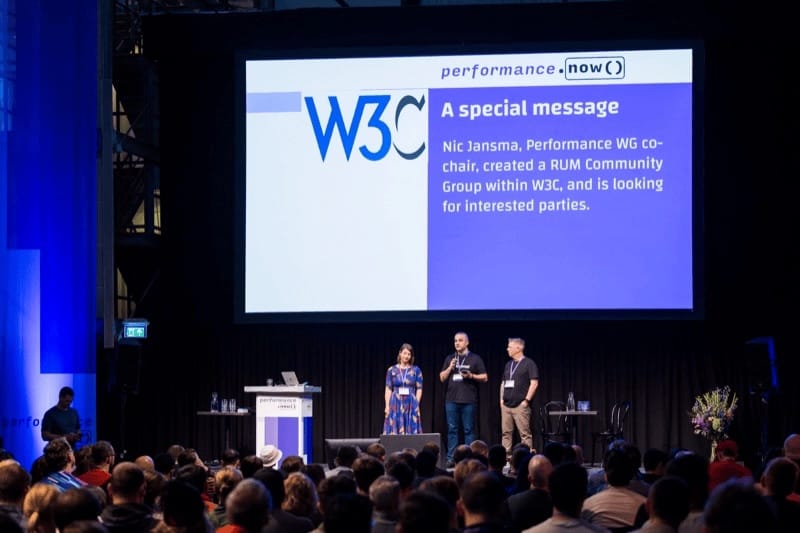
That’s also where this top secret meeting was – about twelve of us in that church backroom. We’ve been striving to have a meeting every month since then (though we missed a couple… summer and holidays season get to all of us), and are currently at 75 members.
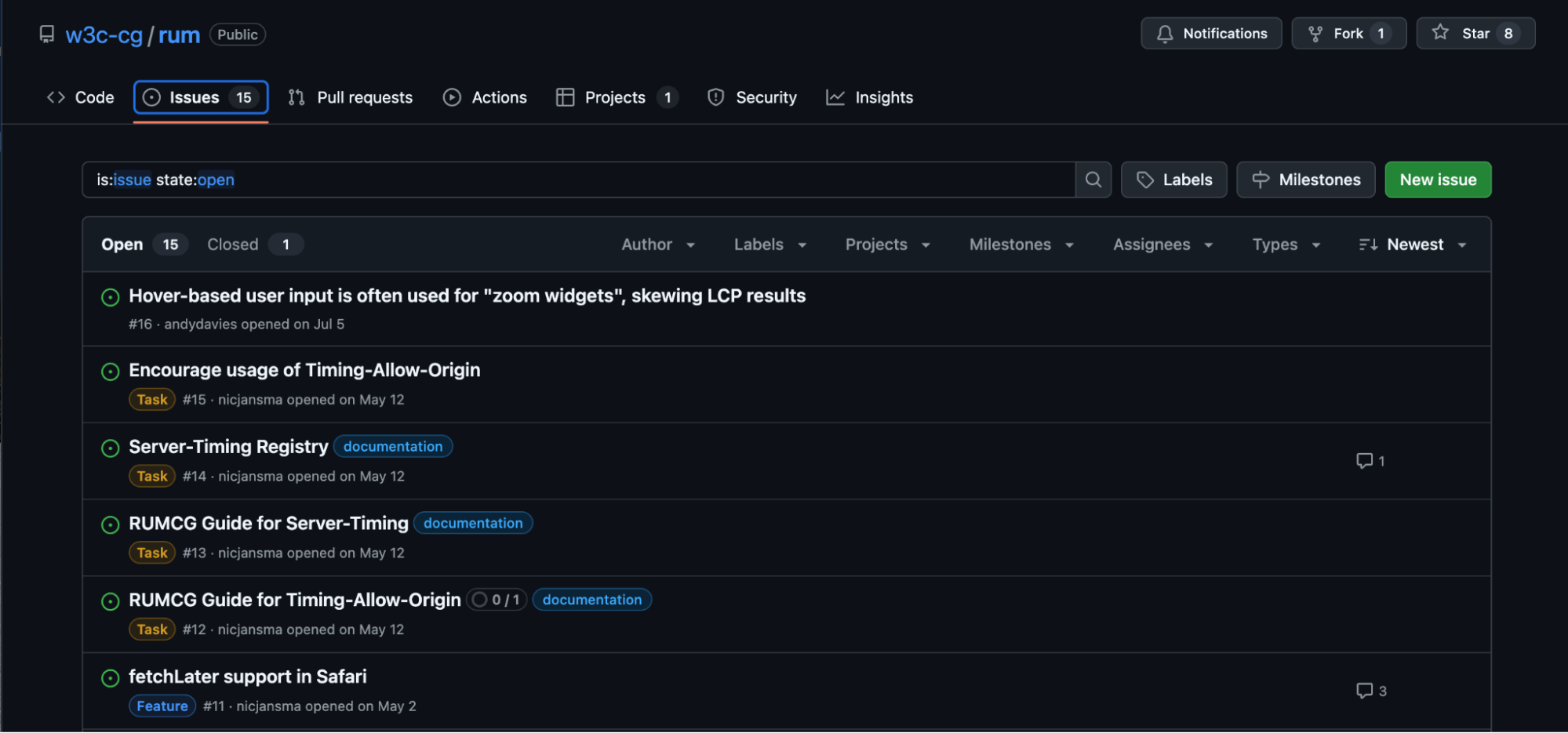
We track everything on a GitHub board where people can submit issues and we vote on what to discuss next. All our issues are tracked there – you can see what we’re discussing, vote on priorities, add your own issues.
About the group
- Forum for discussing RUM-related topics
- No membership in W3C required (no fees)
- Audience: Developers, Sites deploying RUM, 3rd-party RUM providers
- Direct feedback and input to browser vendors, CDNs
- Deliverables: Research + reports, Guiding principles, Opinions we could share with broader community (e.g. WebPerf WG), Test cases
- Not: Specs
A W3 Community group is not the same as a W3 Working Group, but we are tightly coupled and source of feedback and prioritization.

Who’s part of this?
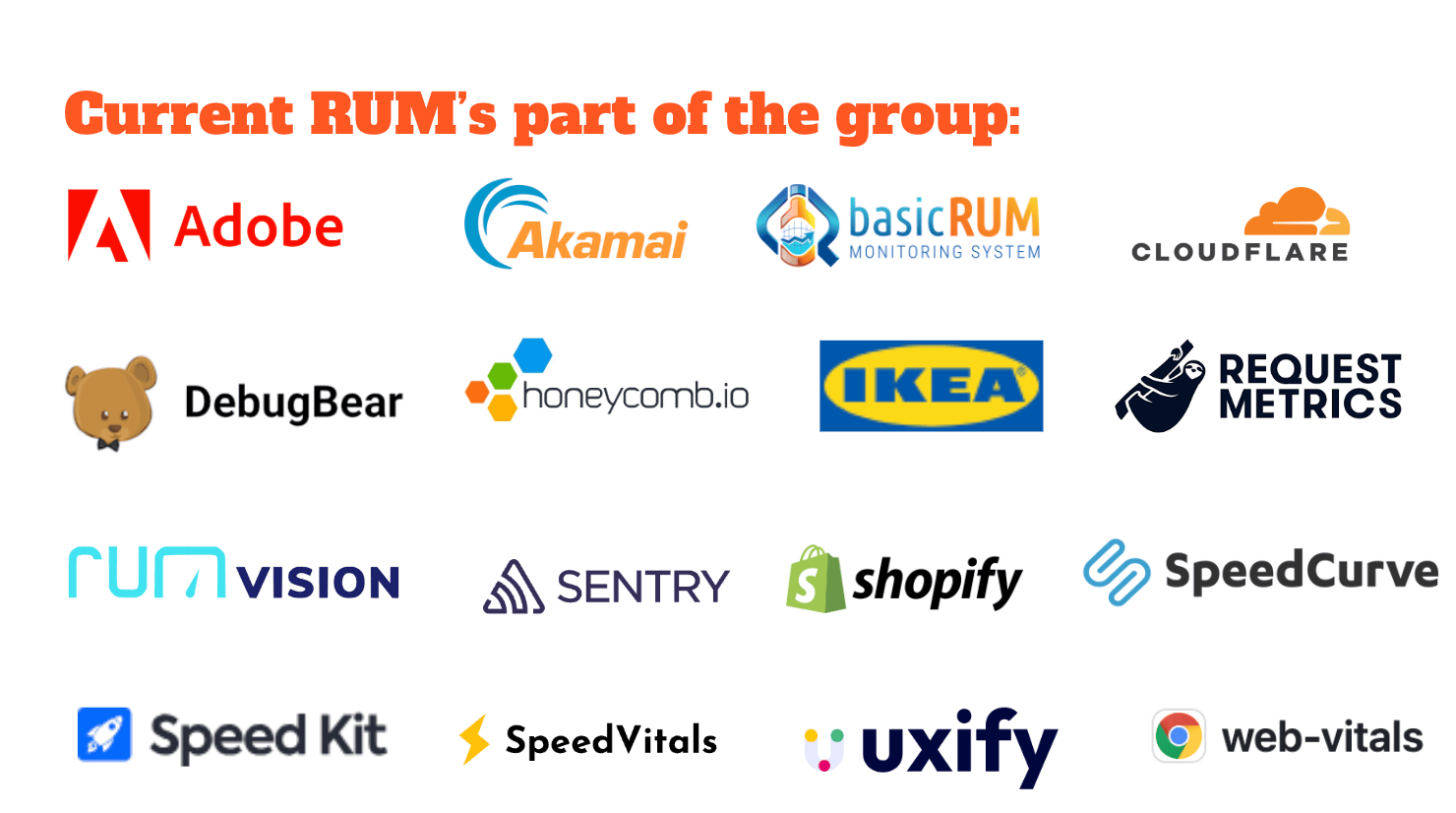
Posted here. The diversity in the group makes it an enormously interesting platform to discuss issues such as:
- RUM vendors (mPulse, RUMvision, Sentry, SpeedCurve, Shopify, IKEA, and many more)
- CDN’s (Cloudflare, Akamai)
- Browsers (Chrome, Firefox – and hey WebKit folks, we’d love it if you joined!)
- Developers and practitioners looking for insight
Looking back at 2025
12 meetings in, multiple updates from browser vendors and great discussion including:
- CDN’s and server timing – visibility into edge timing, cache/hit, origin timing by default for several of these vendors today
- SPA challenges and how to better observe them – feedback of soft navigations API
- Google Baseline and integration into our toolsets and public datasets
- CWV adoption in Webkit – our holiday wish!
- Header adoption (TAO, Server-timing)
- RUM Archive
Not to mention, a fan favorite, Barry’s Bytes. Barry Pollard has provided Chrome updates, announcements around origin trials, feature availability as well as DevTools – updates and direct feedback on the APIs and tooling we all interact with on a daily basis. We’ve also had great sessions with Mozilla and the opportunity to discuss alignment across browsers.

While Google has come a long way in AI image generation, Barry’s dino is forever immortalized.
Real user meeting (RUM RUM)
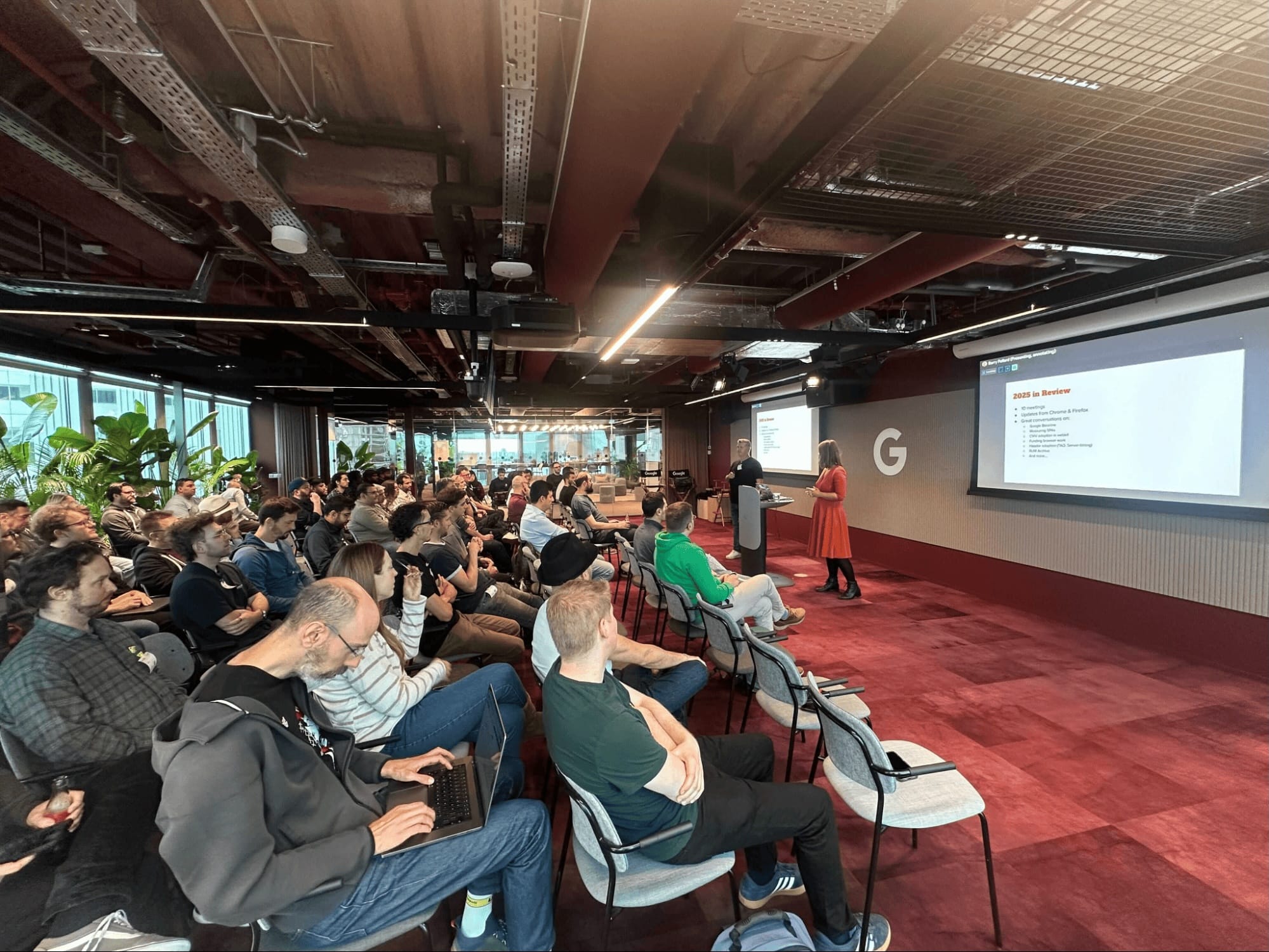
Our last meeting was actually a real face to face meetup prior to the performance.now() conference. Instead of a backroom in the church, we gathered at Google’s Amsterdam office (thanks for hosting friends!) in a “sold out” meeting. It was fantastic to see after a year – the enthusiasm around this group.
We had presentations on what we do with our group, Firefox and Chrome shared updates. The presentations were great, but it was even more awesome to meet everyone face to face and share insights, learnings and topics we’re all tuned in to. We’re definitely on for next year!
Landing the Big One: cross-browser Core Web Vitals
When we founded the RUMCG last year – we didn’t yet know LCP and INP were going to be part of Interop 2025. Fast forward to today, Chrome and Firefox are on par with these metrics with Safari following closely behind – by adding it last Friday (December 12th).
All this feature parity sounds great, but here’s a question: are they actually measuring the same thing? It’s going to be a challenge which is precisely where RUM comes in. We’re looking forward to more discussion where we can share insights, compare notes, and help shape the future for these APIs.
2026 Headwinds
Some questions we’re going to be wrestling with:
AI traffic: Is it even RUM? AI agents are hitting websites now. They’re not real users. Should RUM track them? Do they skew your metrics? Or is this traffic we need to understand? Should we be thinking more about optimizing for these artificial users? What about when an AI agent is shopping on behalf of a user? There’s a human involved, but they’re not on your site. Does that count as user experience? Should RUM measure it?
Cross-browser LCP/INP – are they the same? Firefox and Safari shipping these metrics is great. But are they measuring the same thing? When your RUM dashboard shows different numbers across browsers, is that real differences or implementation quirks?
Soft navigations… Chrome’s shipping soft navigation support for SPAs. Firefox and Safari aren’t. So how do RUM tools handle this? Different measurement per browser? Still in a world of polyfills? Do they even compare?
Other browser API’s: we have a whole list we’d love more support on. But it’s a big list, and it’d be great to see better browser adoption of web performance measuring API’s.
Join us!
We meet monthly and communicate often via a dedicated Slack channel. We share insights and care deeply about user focused observability.
Sound like you? Well, join us!
You might benefit from RUMCG if you:
- Implement RUM at your company and struggle with the various browser APIs
- Build RUM tooling and want to influence future standards
- Work for a CDN or browser vendor and are looking for feedback
- Get frustrated by inconsistencies across RUM vendors and want to see more alignment on standards and best practices
- Are looking for more visibility into upcoming web performance features
- Have opinions and insights around getting better visibility into AI generated web visits
Can’t commit to meetings? Meeting notes are public: https://github.com/w3c-cg/rum/tree/main/meetings
The webperf Slack channel is a great place to lurk and hear more.
Ready to join? https://www.w3.org/community/rumcg/
Happy holidays all (yes, we dressed up for the occasion!)

Next meeting: Wednesday Feb.11, 2026